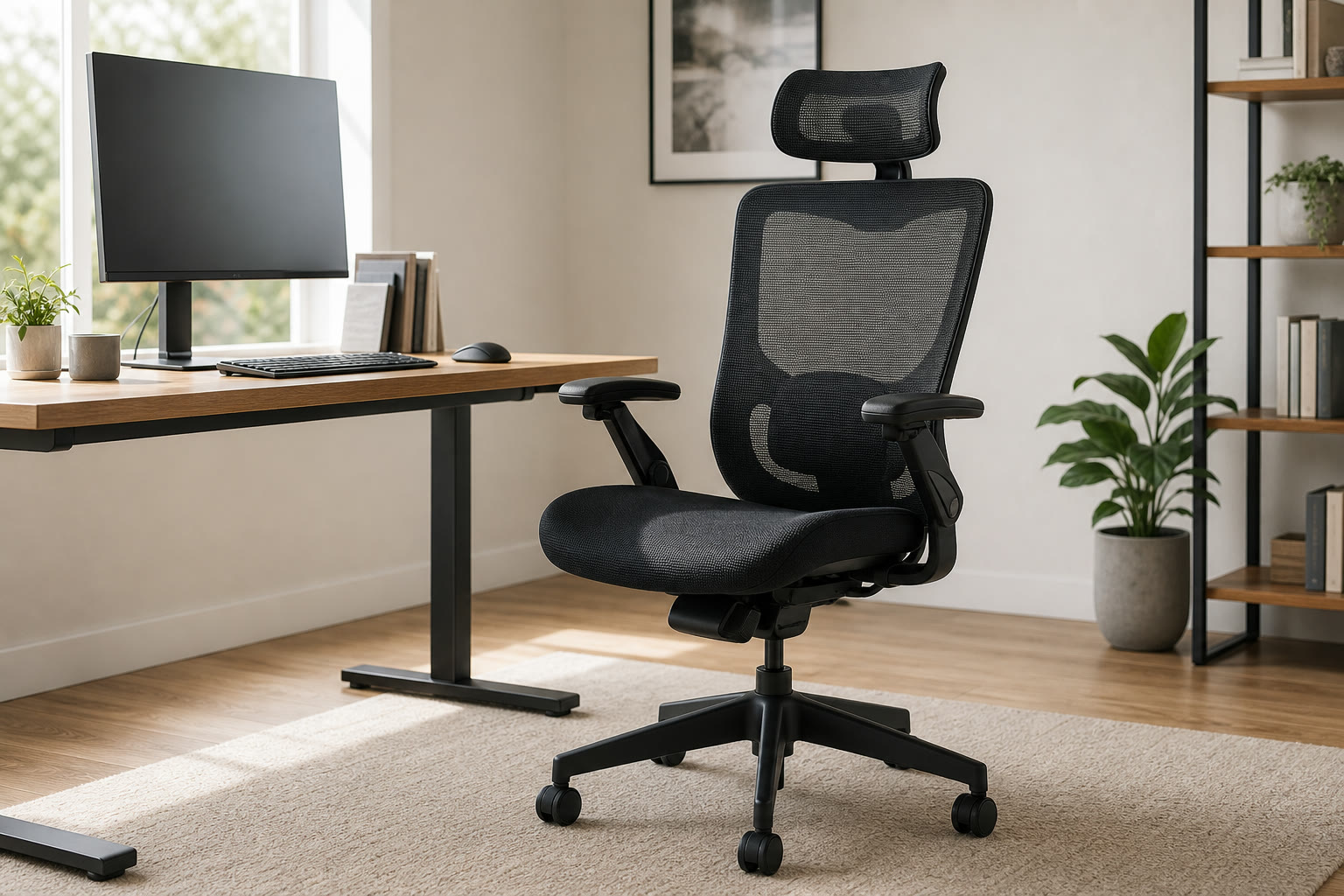

330-lb lumbar model

High-back headrest model
Quick verdict
A practical value pick when breathable mesh, adjustable lumbar support, and space-saving arms matter more than premium materials.
- More supportive workdays: adjustable lumbar support helps reduce the unsupported lower-back gap
- Cooler seating: mesh improves airflow during longer sessions
- Better for compact desks: flip-up arms make it easier to store the chair beneath a desk
How we evaluated it: This is a research-based assessment. We did not receive a free sample or personally test these chairs. We reviewed the current Amazon listings and published specifications on July 28, 2026. Both product images are supplied through Amazon Creators API.
Check TRALT chair price & availability
Long workdays can turn a basic chair into a daily source of pressure: a warm back, unsupported posture, tired shoulders, and armrests that keep the chair from fitting under the desk. The TRALT office chair campaign points to two closely related ergonomic mesh chairs sold on Amazon under the Ergalithic name. Both aim to solve those everyday problems without moving into premium-chair pricing.
Our short verdict: This looks like a sensible value option for a home office when breathable mesh, adjustable lumbar support, and space-saving flip-up arms matter more than luxury materials or highly customizable ergonomics. Buyers should measure carefully and treat long-term durability as an open question rather than a guarantee.
Best for: home-office users, students, shared workspaces, and shoppers who want a supportive mesh chair at a moderate price.
Think twice if: you need premium upholstery, independent ergonomic certification, a long documented warranty, or adjustments such as seat-depth and arm-width control.
TRALT office chair review: the key facts
| Amazon model reviewed | Ergalithic 330-lb mesh ergonomic desk chair (ASIN B0D9NKJTJG) |
|---|---|
| Published highlights | Mesh back, 3D lumbar support, swivel base, wheels, and flip-up arms |
| Published capacity | 330 lb |
| Alternative version | High-back version with headrest and lumbar support (ASIN B0D9MHLDFQ) |
Brand-name note: the Amazon creator campaign refers to “TRALT,” while the linked listings currently display “Ergalithic.” Confirm the seller, model, dimensions, included parts, return terms, and warranty on the live listing before ordering. Price, availability, and specifications can change.
Check current price and details on Amazon
The pain point: a chair that fights your workday
A chair does not have to feel painful immediately to be a poor fit. Small issues compound: a lumbar curve that misses your lower back, fixed arms that lift your shoulders, a backrest that traps heat, or a seat that forces your feet away from the floor. After several hours, users may find themselves leaning forward or shifting constantly.
The useful question is not whether one chair can “fix posture.” No chair can promise that. The question is whether its adjustments make a neutral, varied sitting position easier to maintain. TRALT’s value proposition is built around three practical solutions:
- Breathable mesh: intended to improve airflow compared with a thick, fully upholstered back.
- Adjustable lumbar support: designed to let the chair meet the lower back instead of leaving an unsupported gap.
- Flip-up arms: useful when the chair needs to slide beneath a desk or when a task requires more side-to-side freedom.
What stands out
1. Practical lumbar adjustment
The main model advertises “3D lumbar” support. That matters only if the mechanism can be positioned comfortably for your body, so adjustment range is more important than the label itself. Start with mild contact at the natural curve of the lower back. More pressure is not automatically better, and an aggressive setting may be uncomfortable for some users.
2. Mesh for warmer rooms and longer sessions
Mesh can be a good match for a warm office or anyone who dislikes the heat retention of padded chair backs. It also gives the chair a lighter visual profile. The trade-off is that mesh tension and edge comfort vary by body shape, and the material may feel less plush than foam or fabric.
3. Flip-up arms solve a real space problem
Many compact desks have a shallow apron or low drawer that blocks fixed arms. Raising the arms can let the chair move closer to the desk and store more neatly. This can reduce the temptation to perch at the front edge of the seat. However, flip-up arms are not the same as fully adjustable arms; check whether the live listing offers the height, width, or angle control you need.
4. A stated 330-lb capacity
The published capacity gives the main model broader appeal, but a weight rating alone does not confirm comfort for every body type. Seat width, usable seat depth, arm spacing, backrest height, and cylinder range are just as important. Measure your existing chair and compare those numbers with the current product diagram.
How we handled customer-review evidence
We do not reproduce Amazon star ratings or individual customer-review quotations on this page. Ratings change, and a small selection of excerpts can create a misleading impression. Amazon also limits how Associates may display its customer-review and rating content. On the live listing, read recent critical and positive reviews, sort by “most recent,” and look for repeated patterns involving assembly, fit, noise, missing parts, and customer support.
Customer comments are not a substitute for independent durability testing. They cannot by themselves establish whether a chair will stay quiet, retain mesh tension, or maintain smooth height adjustment after years of use.
Pros and limitations
Potential advantages
- Breathable mesh back for better airflow
- Adjustable lumbar support
- Flip-up arms for compact desks
- Published 330-lb capacity on the main model
- Two configurations available to compare
Limitations to consider
- No hands-on test by Thinking Reviews
- Brand naming differs between campaign and listing
- Fewer adjustments than many premium task chairs
- Comfort depends heavily on body proportions
- Long-term mesh and mechanism durability remain unverified
Which version should you choose?
The 330-lb 3D-lumbar version is the simpler choice if you prioritize lower-back support and do not need a headrest. The high-back version with a headrest may suit users who prefer upper-back and head contact while reclining. A headrest is not inherently more ergonomic; it should support the head without pushing it forward during normal work.
Quick buying decision
| Option | Best when | Main trade-off |
|---|---|---|
| 330-lb lumbar model | Lumbar adjustment, airflow, and a moderate price are the priorities | No headrest and fewer adjustments than a premium task chair |
| High-back headrest model | You prefer upper-back and head support | Fit depends strongly on torso height and proportions |
| Premium ergonomic chair | Seat-depth, arm-width, and highly granular adjustments matter | Substantially higher purchase price |
See the current chair offer on Amazon
Five checks before you buy
- Measure your desk clearance. Compare floor-to-desk and drawer clearance with the chair’s arm and seat height ranges.
- Check usable seat size. The outside width is less useful than the space between the arms and the flat sitting area.
- Confirm return and warranty terms. Chairs are personal-fit products; a reasonable return path matters.
- Review the latest listing. Sellers may update components, bundles, instructions, or specifications.
- Plan movement into the day. Even a well-fitted chair works best with regular position changes and short standing or walking breaks.
For a wider comparison, see our guide to the best office chairs.
Frequently asked questions
Is the TRALT office chair good for all-day work?
Its mesh back, adjustable lumbar support, and arms are relevant for longer sessions, but “all-day comfort” depends on individual fit and work habits. Compare dimensions carefully, set the chair so your feet are supported, and change positions regularly.
Does it include a headrest?
The B0D9NKJTJG model reviewed in the main table does not emphasize a headrest. The B0D9MHLDFQ alternative does. Check the exact ASIN and current listing images before buying.
Is the 330-lb rating a comfort guarantee?
No. It is a published capacity, not proof that the seat dimensions, arm spacing, or lumbar curve will fit every user. Size and adjustment range matter alongside capacity.
Is it really TRALT or Ergalithic?
The creator campaign uses TRALT, while the two linked Amazon listings displayed Ergalithic during our July 28, 2026 check. This discrepancy is why we recommend confirming the current brand, seller, and model details on Amazon.
Final verdict
The TRALT/Ergalithic mesh chair earns consideration because it addresses common home-office problems with relevant, understandable features: airflow, lumbar contact, and arms that can move out of the way. Those features are enough to keep it on a shortlist, but they do not replace a dimension check or evidence of long-term durability.
If the measurements fit your body and desk—and the live return and warranty terms are acceptable—the main 330-lb model looks like the better starting point. Shoppers who want a headrest can compare the high-back alternative before deciding.
View current TRALT/Ergalithic chair details
Amazon price, availability, specifications, seller, and return terms may change. Verify the live listing before purchasing.


I’m 5’6″ and my legs are on the shorter side. Before I buy the TRALT-style mesh chair, how can I tell if the seat depth will push the backs of my knees like my last “ergonomic” chair did?
Seat depth fit matters most for avoiding knee pressure. When you sit, you should be able to slide back until your thighs are supported without the chair forcing your knees upward or pressing behind them. If your hips feel “pinned” and there’s no room to keep a slight gap behind your knees, it’s a sign the seat depth is too long for you. Since the TRALT models are variations of the same design, double-check whether the seat has any usable depth adjustment in the listing photos/specs and prioritize models with meaningful adjustment if you’re between sizes.
I bought the higher TRALT/Ergalithic-style mesh chair with the headrest, but my monitor is on a laptop stand, so the screen sits lower than a normal desktop. What headrest height/angle setup should I try so the headrest doesn’t end up pressing the back of my skull?
Set the headrest so it supports the back of your skull lightly without pushing your head forward. In a setup where your monitor sits lower (because it’s on a laptop stand), start with the chair adjusted so you’re sitting upright with shoulders relaxed, then raise the headrest to your highest comfortable position. After that, fine-tune the angle: move it until your neck feels supported when you sit back, but you’re not forcing your chin up or feeling pressure on the back of your skull. If it still presses, lower the chair height or reposition the headrest so it meets the skull—not the upper back of your head.