
You’ll find the 10 best rowing machines for 2026 across magnetic, water, and foldable options. Think Concept2 RowErg with its PM5 monitor, MERACH water rowers with Bluetooth app, and YOSUDA models offering 16 resistance levels or quick folding. Look for 285–500 lb weight capacities, setup in about 10–20 minutes, and Bluetooth connectivity for apps and races. Monitors show distance, time, calories, and strokes, with compact designs saving space. More details await as you explore further.
| YOSUDA Magnetic/Water Rowing Machine with Bluetooth App | 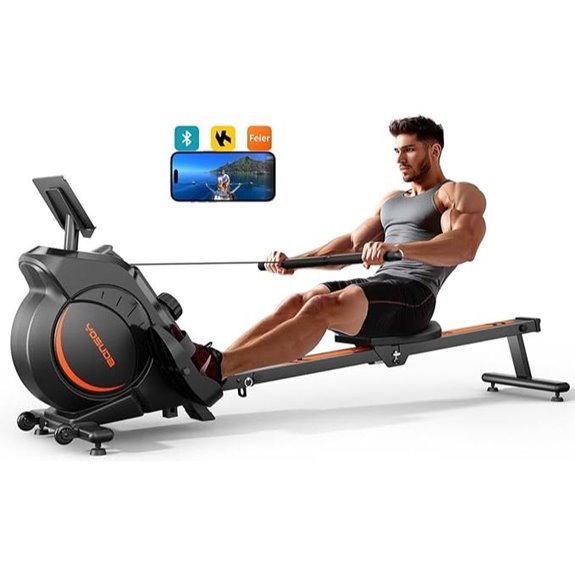 | Best Overall | Type of resistance: Magnetic/Water (dual system) | Bluetooth / app connectivity: Bluetooth app supported | Weight capacity / max user weight: 350 lbs | VIEW LATEST PRICE | See Our Detailed Review |
| Concept2 RowErg Indoor Rowing Machine with PM5 Monitor |  | Heavy-Duty Performance | Type of resistance: Air resistance (RowErg) | Bluetooth / app connectivity: PM5 monitor with no app specified (not Bluetooth) | Weight capacity / max user weight: 500 lbs | VIEW LATEST PRICE | See Our Detailed Review |
| MERACH Water Rowing Machine with Monitor and App | 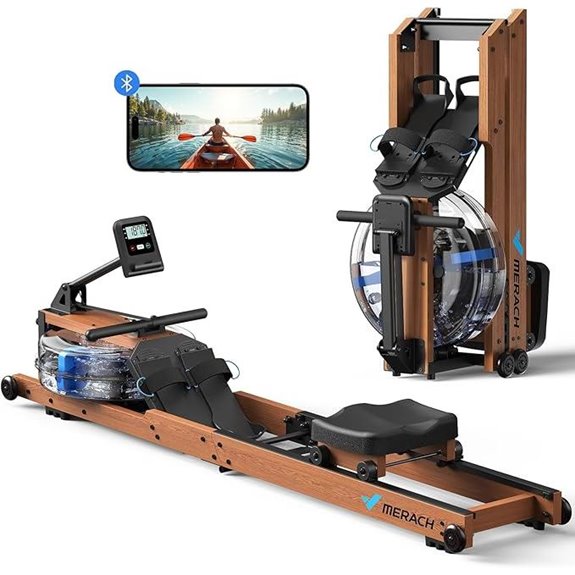 | Foldable Versatility | Type of resistance: Water resistance | Bluetooth / app connectivity: Bluetooth app integration | Weight capacity / max user weight: 400 lbs | VIEW LATEST PRICE | See Our Detailed Review |
| YOSUDA Foldable Water Rowing Machine with Monitor |  | Space-Saver Wonder | Type of resistance: Water resistance | Bluetooth / app connectivity: Bluetooth app integration | Weight capacity / max user weight: 400 lbs | VIEW LATEST PRICE | See Our Detailed Review |
| Dripex Magnetic Rowing Machine with Bluetooth LCD Monitor | 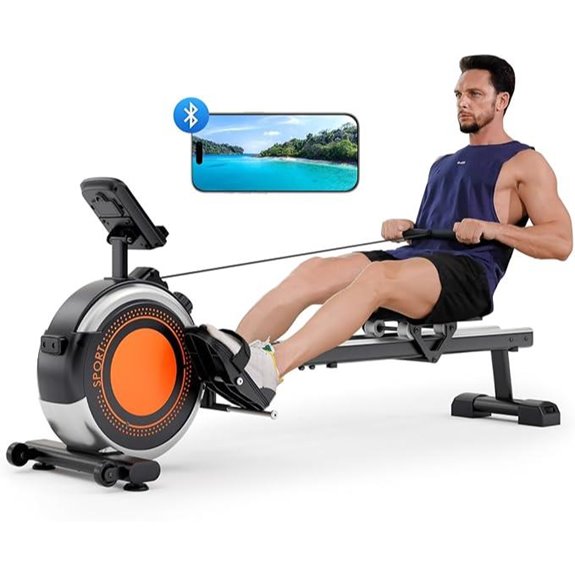 | Quiet & Smooth | Type of resistance: Magnetic resistance | Bluetooth / app connectivity: Bluetooth connectivity + live training videos | Weight capacity / max user weight: 350 lbs | VIEW LATEST PRICE | See Our Detailed Review |
| Concept2 RowErg D Indoor Rowing Machine with PM5 |  | Pro-Grade Experience | Type of resistance: Air resistance | Bluetooth / app connectivity: Bluetooth/ANT+ compatible (PM5 ecosystem) | Weight capacity / max user weight: 500 lbs | VIEW LATEST PRICE | See Our Detailed Review |
| Sunny Health Magnetic Rowing Machine with App Connectivity | 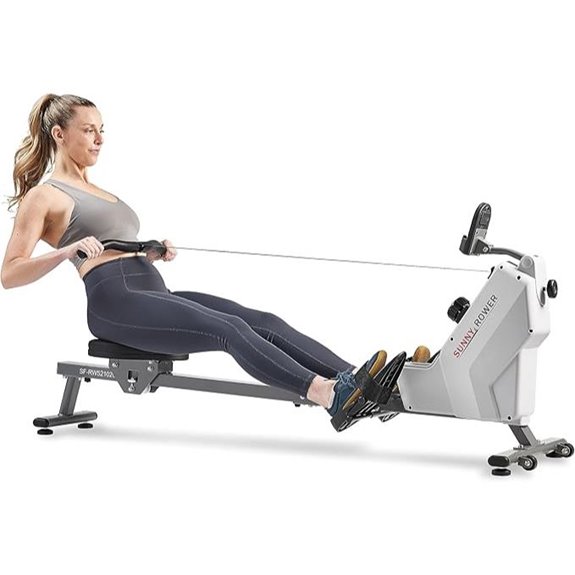 | App-Driven Accountability | Type of resistance: Magnetic resistance | Bluetooth / app connectivity: App connectivity (SunnyFit) | Weight capacity / max user weight: 285 lbs | VIEW LATEST PRICE | See Our Detailed Review |
| MERACH Pro-Grade Rowing Machine with App Courses |  | Smart & Silent | Type of resistance: Magnetic resistance | Bluetooth / app connectivity: MERACH app with 1000+ classes | Weight capacity / max user weight: 400 lbs | VIEW LATEST PRICE | See Our Detailed Review |
| Rowing Machine with 16-Level Quiet Resistance and LCD Monitor | 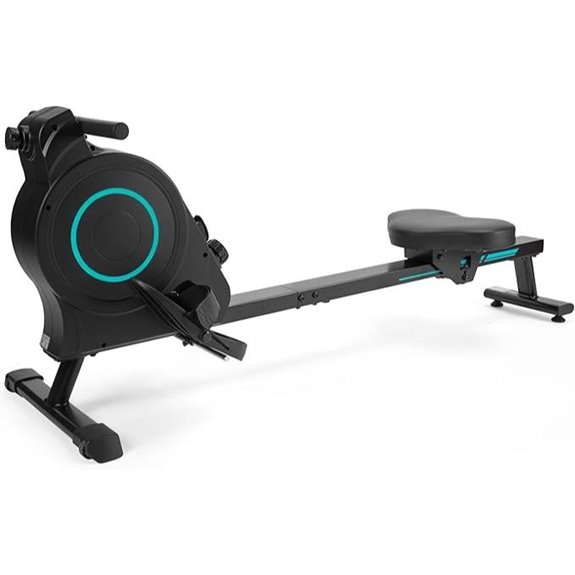 | Quiet Home Use | Type of resistance: Magnetic resistance | Bluetooth / app connectivity: LCD monitor with device holder (no app) | Weight capacity / max user weight: 350 lbs | VIEW LATEST PRICE | See Our Detailed Review |
| Concept2 RowErg Indoor Rowing Machine with PM5 | 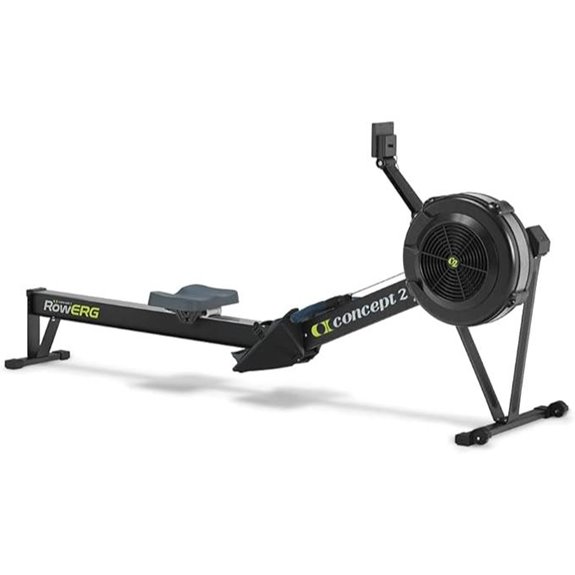 | Classic Rowing Power | Type of resistance: Adjustable air resistance | Bluetooth / app connectivity: PM5 with Bluetooth connection | Weight capacity / max user weight: 500 lbs | VIEW LATEST PRICE | See Our Detailed Review |
More Details on Our Top Picks
YOSUDA Magnetic/Water Rowing Machine with Bluetooth App
If you’re shopping for a home rowing machine in 2026, the YOSUDA Magnetic/Water Rowing Machine with Bluetooth App stands out for users who want versatile resistance and modern connectivity. You get magnetic resistance with a 14 lbs flywheel and 16 levels, offering double resistance versus basic models. It engages about 90% of your muscle groups, targeting legs, core, and arms, useful for rehab, fat loss, shaping, and strength. The LCD monitor shows data, and Bluetooth lets you pair an app for races. It funds easy setup in 20 minutes, folds with wheels, and supports up to 350 pounds.
- Type of resistance:Magnetic/Water (dual system)
- Bluetooth / app connectivity:Bluetooth app supported
- Weight capacity / max user weight:350 lbs
- Foldable / storage-friendly design:Not specified as foldable
- Monitor / performance tracking:LCD monitor with rowing data
- Target use / suitability:Home use; rehab, weight loss, strength
- Additional Feature:Tall-athlete seat comfort
- Additional Feature:20-minute assembly
- Additional Feature:60% space saver
Concept2 RowErg Indoor Rowing Machine with PM5 Monitor
The Concept2 RowErg Indoor Rowing Machine with PM5 Monitor stands out for users who want a reliable, full-body workout with detailed performance data. You’ll get adjustable air resistance, easy storage, and a tall-leg design for stability. The PM5 Monitor tracks distance, speed, pace, calories, and watts, drawing power from the flywheel to save battery life. It separates into two pieces for storage and has caster wheels for mobility. Dimensions are 24D x 96W x 20H inches, supporting up to 500 pounds. Warranty covers 2 and 5 years, with strong reviews and widespread availability.
- Type of resistance:Air resistance (RowErg)
- Bluetooth / app connectivity:PM5 monitor with no app specified (not Bluetooth)
- Weight capacity / max user weight:500 lbs
- Foldable / storage-friendly design:Easily separates into two pieces for storage
- Monitor / performance tracking:PM5 monitor with performance metrics
- Target use / suitability:All ages, all abilities (general use)
- Additional Feature:Tall legs design
- Additional Feature:Includes device holder
- Additional Feature:Easy two-piece storage
MERACH Water Rowing Machine with Monitor and App
MERACH’s Water Rowing Machine with Monitor and App stands out for beginners and intermediate rowers who want a sturdy, space-saving option, thanks to its foldable design that stores upright in 180°. You get a 400 lb weight capacity, solid wood construction for stability, and a compact 60D x 18W x 30H inches footprint. The monitor shows distance, time, calories, speed, and stroke count, with Bluetooth to sync data to your phone or tablet. Assembly is quick—about 10 minutes with 98% pre-assembled parts. It’s durable, leak-proof when stored upright, and backed by a 1-year warranty.
- Type of resistance:Water resistance
- Bluetooth / app connectivity:Bluetooth app integration
- Weight capacity / max user weight:400 lbs
- Foldable / storage-friendly design:Foldable with 180° storage
- Monitor / performance tracking:Dedicated monitor with distance/time/calories/speed/stroke
- Target use / suitability:All skill levels
- Additional Feature:Foldable with 180° storage
- Additional Feature:98% pre-assembled
- Additional Feature:Wood and metal build
YOSUDA Foldable Water Rowing Machine with Monitor
The YOSUDA Foldable Water Rowing Machine with Monitor stands out for its space-saving design and sturdy build, making it a strong pick if you need a full-body cardio machine that fits a smaller home. You get 60% folded storage, a 400 lb weight capacity, and solid beech wood construction with FSC certification. The 22L water tank provides authentic resistance that scales with your pace, while the Bluetooth app tracks calories, distance, speed, strokes, and time. Setup is quick, about 10 minutes, with 98% pre-assembled parts and a 2-year warranty for parts. It suits all fitness levels.
- Type of resistance:Water resistance
- Bluetooth / app connectivity:Bluetooth app integration
- Weight capacity / max user weight:400 lbs
- Foldable / storage-friendly design:Foldable, saves space
- Monitor / performance tracking:Bluetooth-enabled monitor with metrics
- Target use / suitability:All fitness levels
- Additional Feature:FSC-certified wood
- Additional Feature:22L water tank
- Additional Feature:2-year replacement warranty
Dripex Magnetic Rowing Machine with Bluetooth LCD Monitor
Dripex stands out for home workouts with its 16-level magnetic resistance and Bluetooth LCD monitor, making it a solid pick for everyday runners and rowers who want adjustable effort without noise. You get a 12 lbs flywheel, high-energy magnets, and up to 66 lbs of resistance, all while staying quiet. The dual slide rails provide stability, with an ergonomic padded seat and a 48.8-inch slide for heights from 45 to 65 inches. The LCD tracks distance, time, calories, count, and total count, and Bluetooth lets you sync devices and access live training videos. Assembly takes about 20 minutes.
- Type of resistance:Magnetic resistance
- Bluetooth / app connectivity:Bluetooth connectivity + live training videos
- Weight capacity / max user weight:350 lbs
- Foldable / storage-friendly design:Compact design, vertical storage
- Monitor / performance tracking:LCD monitor with metrics
- Target use / suitability:All fitness levels; home use
- Additional Feature:16-level magnetic resistance
- Additional Feature:66 lb max resistance
- Additional Feature:Front transport wheels
Concept2 RowErg D Indoor Rowing Machine with PM5
If you’re after a proven, durable machine for home use or serious training, the Concept2 RowErg D with PM5 is a standout choice. This model is the best-selling rowing machine for over 40 years, suitable for home gyms, facilities, and competitive training. It features an integrated device holder for smartphones or tablets, a PM5 monitor, Bluetooth and ANT+ compatibility, and adjustable air resistance with damper settings from 1 to 10. Dimensions are 24D x 95W x 14H inches, with a 9×4 feet clearance. It supports up to 500 pounds, stores in two pieces, and includes a 2-year warranty.
- Type of resistance:Air resistance
- Bluetooth / app connectivity:Bluetooth/ANT+ compatible (PM5 ecosystem)
- Weight capacity / max user weight:500 lbs
- Foldable / storage-friendly design:Separates into two pieces for storage
- Monitor / performance tracking:PM5 monitor (advanced metrics)
- Target use / suitability:All ages and abilities
- Additional Feature:PM5 data tracking
- Additional Feature:USB workout save
- Additional Feature:Frameless quick-release
Sunny Health Magnetic Rowing Machine with App Connectivity
This magnetic rowing machine from Sunny Health stands out for its combination of quiet resistance and app connectivity, making it a solid choice if you want guided workouts without loud noise. It’s built with sturdy steel and supports up to 285 lbs, with a foldable design for easy storage. The 8-level magnetic resistance offers a quiet row, while the LCD shows distance, time, counts, and calories. You get free SunnyFit App access with 1,000+ trainer-led workouts and 10,000+ virtual tours, plus progress tracking. Easy assembly, US-based support, and a 3-year frame warranty add value for your home gym.
- Type of resistance:Magnetic resistance
- Bluetooth / app connectivity:App connectivity (SunnyFit)
- Weight capacity / max user weight:285 lbs
- Foldable / storage-friendly design:Foldable, easy storage
- Monitor / performance tracking:LCD monitor with progress tracking via app
- Target use / suitability:All ages; fitness and rehab
- Additional Feature:Free SunnyFit app
- Additional Feature:3-year frame warranty
- Additional Feature:20-inch seat height
MERACH Pro-Grade Rowing Machine with App Courses
The MERACH Pro-Grade Rowing Machine with App Courses stands out for users who want a high-weight capacity and a rich digital training library without needing an external power source. You get a 400 lb max load, a solid alloy steel build, and 73.9 x 32 x 17.8 inches of footprint, all in black. It uses professional-grade magnetic resistance up to 130 lbs and a self-powered system that includes 5W USB-C charging. The unit offers three resistance methods and a 49.2-inch sliding distance. The MERACH App provides 1,000+ classes, with LED metrics and a 12-month warranty for peace of mind.
- Type of resistance:Magnetic resistance
- Bluetooth / app connectivity:MERACH app with 1000+ classes
- Weight capacity / max user weight:400 lbs
- Foldable / storage-friendly design:Not specified as foldable
- Monitor / performance tracking:LED display with app data integration
- Target use / suitability:All levels (pro-grade capability)
- Additional Feature:Self-powered system
- Additional Feature:3 resistance methods
- Additional Feature:20% longer leg extension
Rowing Machine with 16-Level Quiet Resistance and LCD Monitor
A Rowing Machine with 16-Level Quiet Resistance and LCD Monitor stands out for home and apartment use thanks to its silent, magnetic resistance and clear performance readouts. You get 16 adjustable levels, a 350 lb capacity, and a compact frame with transport wheels for easy moving. It operates below 30 dB, so it stays quiet in shared spaces. The ergonomic seat, adjustable non-slip pedals, and sweat-resistant handles improve comfort and grip. The LCD Monitor tracks time, speed, distance, and calories, plus a built-in device holder. Arrives 85% pre-assembled with guides and videos for quick setup and storage.
- Type of resistance:Magnetic resistance
- Bluetooth / app connectivity:LCD monitor with device holder (no app)
- Weight capacity / max user weight:350 lbs
- Foldable / storage-friendly design:Compact & space-saving design
- Monitor / performance tracking:LCD Monitor with time/speed/distance/calories
- Target use / suitability:Home/office/apartment use
- Additional Feature:Quiet operation (<30 dB)
- Additional Feature:Sweat-resistant handles
- Additional Feature:Transport wheels
Concept2 RowErg Indoor Rowing Machine with PM5
Concept2 RowErg Indoor Rowing Machine with PM5 stands out for its PM5 monitor, which supports Bluetooth and ANT+ connections to apps and heart rate monitors, making it a strong choice if you want a rower that easily integrates with other fitness tools. You’ll get a Model D frame, 96 by 24 by 14 inches, and a 57.32-pound unit built for durability with aluminum front legs and a stainless steel track. The PM5 connects to 40+ apps, and the air resistance is adjustable via the damper. It supports up to 500 pounds and stores easily with caster wheels.
- Type of resistance:Adjustable air resistance
- Bluetooth / app connectivity:PM5 with Bluetooth connection
- Weight capacity / max user weight:500 lbs
- Foldable / storage-friendly design:Separates into two pieces for storage
- Monitor / performance tracking:PM5 monitor with Bluetooth/ANT+ data
- Target use / suitability:All ages and abilities
- Additional Feature:9×4 feet space
- Additional Feature:Bluetooth/ANT+ compatibility
- Additional Feature:Two-piece storage
Factors to Consider When Choosing Rowing Machine
When you choose a rowing machine, compare resistance types (water, air, magnetic, or hydraulic) and how that feel matches your workouts, plus check weight capacity to cover you and any helpers. Look at space needs, from compact models that fold to full-length machines, and note dimensions, user height limits, and room layout, so setup fits your space and storage ease. Also consider connectivity options, app compatibility, built-in programs, and price ranges, then balance assembly time, warranty, and service availability to match your budget and routine.
Resistance Type Differences
Rowing machines come in three main resistance types—air, magnetic, and water—and each affects feel, noise, and performance differently. You’ll notice air models vary with your speed, offering a natural ride but louder operation, especially at higher strokes. Magnetic resistance provides smooth, quiet workouts, with adjustable levels that are easy to switch during a session. Water machines use a tank and actual paddles, delivering a realistic feel that changes with water level and pace. If you want minimal noise and simple control, magnetic might fit best; if you crave realism and a dynamic feel, try water; for budget-conscious buyers who don’t mind some sound, air could work. Consider your goals, space, and tolerance for noise when choosing. Price ranges commonly start around $800 and rise above $2,000.
Weight Capacity Variations
Weight capacity varies widely across rowing machines, and that matters as much as the basics like resistance type and size. Most models support 285 to 500 pounds, which covers a wide range of users. A higher capacity often means sturdier construction, better stability, and longer durability during workouts. Always compare your body weight to the machine’s limit to ensure safe use and effective workouts. Some models, like those with a 400-pound capacity, are designed for heavier users while still delivering a solid workout experience. When selecting, check the manufacturer’s specifications for weight limits to confirm it fits your needs and safety requirements. Consider how often you’ll use it, and how you’ll store the machine if space is tight. Prioritize fit, safety, and reliability.
Space Requirements
Space requirements matter a lot when choosing a rowing machine. You’ll need to consider footprint and room layout, because sizes vary widely. Some models need about 9×4 feet of space for comfortable use, while others stay compact. Depth can be as little as 39.37 inches, making compact designs fit tighter rooms or alcoves. Folding machines save floor space, with some designs offering up to a 60% storage-area reduction when not in use. Weight and construction affect movement and storage; lighter machines are easier to relocate, sturdier builds may demand more space for stability. Check if the unit segments for storage, since easy disassembly can dramatically reduce needed room. Consider your room’s clearances, doorways, and matting to prevent interference during workouts.
Connectivity Features
Connectivity features matter when you pick a rowing machine because tech options can boost motivation and tracking. Look for Bluetooth connectivity to sync with fitness apps for easy workout logs and progress. Some machines include dedicated monitors that show distance, time, calories burned, and stroke count, giving you real-time feedback. Many models support syncing with smartphone apps, offering interactive classes, training videos, and virtual challenges to keep workouts engaging. Check compatibility with multiple devices and platforms; some rowers connect with over 40 apps for diverse tracking options. Built-in device holders let you place your smartphone or tablet securely for entertainment or on-screen data. Prioritize models with straightforward pairing, clear display, and reliable app support for steady, practical use.
Assembly And Storage
Many rowing machines arrive partly pre-assembled, which can cut setup time to about 10 to 20 minutes, and you’ll appreciate that if you’re eager to start working out quickly. When you shop, look for compact designs that fit small spaces, with some models folding to save up to 60% of their footprint when not in use. Built-in wheels or casters help you move the machine around the room or to a different area without lifting. Some units separate into two pieces, making storage in tight spots easier and boosting portability. Clear assembly instructions, and optional video tutorials, streamline setup, so you can get to exercising sooner rather than later. Prioritize straightforward components and reliable hardware for long-term convenience.
Monitor Metrics Offered
When you’re picking a rowing machine, the monitor metrics it offers should be a top consideration, since they show how you’re performing and progress over time. You’ll see basics like distance, time, calories burned, speed, and stroke count, which help you track progress and set goals. Some models add watts and pace to measure intensity and endurance. Advanced units often include Bluetooth, so you can sync data with apps for deeper analysis. Look for clear display and a user-friendly interface, because you’ll check metrics mid-workout and in reviews later. Ease of visibility matters, especially during training sessions with high effort. Price varies, but higher-end monitors tend to provide more customizable metrics and smoother app connections. Choose a unit that fits your routine and budget.
Durability And Warranty
Durability and warranty matter because a rowing machine should last through years of workouts and varying use. When you pick, consider construction materials—steel or solid wood usually offer more longevity and stability. Check the maximum weight capacity; higher numbers often signal a tougher design that handles intense sessions. Review warranty options from the manufacturer, since a longer period reflects confidence and adds peace of mind. Look for weather-resistant or wear-resistant components that boost lifespan and performance over time. Read customer reviews for durability, as user feedback reveals real-world reliability and common problems. Note quick fixes or parts availability, and compare across models. In short, prioritize sturdiness, capacity, and solid warranty to protect your investment.
Frequently Asked Questions
How Quiet Are Magnetic Versus Water Rowers in Apartments?
Magnetic rowers are generally quieter than water rowers in apartments. You’ll hear soft whirs and a steady hum, usually around 35–50 dB at idle and climbing a bit during sprints. Water rowers produce buoyant splashes and tank slosh, often sounding like gentle waves, roughly 40–60 dB, depending on water level and resistance. If quiet matters most, pick magnetic, cushioned seat, and adjustable tension under $800. For realism, test in-store.
Do Rowers Track Heart Rate Without External Devices?
Yes, some rowers track heart rate without external devices, using built-in sensors in handles or foot rests, or through chest straps linked via Bluetooth on certain models. Expect a basic HR readout on the console, often plus workout zones and target heart rate guidance. Accuracy varies by model, usually within a few beats per minute. If you want reliable stats, pair with a chest strap or watch that supports Bluetooth or ANT+. Check prices around $800–$2,500.
Can You Convert a Non-Rowing Space Into a Cardio Setup?
Yes, you can convert a non-rowing space into a cardio setup, and here’s how you do it practically. Pick a compact cardio base, like a foldable treadmill, a sturdy bike, or a versatile rower, and aim for 3–5 machines total. Measure floor space, choose a 60–90 inch treadmill or 48–52 inch rower, set a budget near $800–$1,800, and verify noise, warranty, and basic features before buying.
Which Models Support Multi-User Profiles and Weights?
Multi-user profiles and weight support vary by model. Look for machines that offer user presets, multiple saved profiles, and weight limits above 300 pounds. Good options include Concept2 Model D/RowErg with optional PM5 profiles, NordicTrack RW900 with multiple user slots and adjustable resistance, and ProForm 750R with user accounts and increased weight capacity. Check advertised weight limits (often 240–330 lb), profile counts, auto-adjust features, and price ranges around $700–$2,000 depending on features.
Are Warranty Terms Affected by Water Versus Magnetic Resistance?
Warranty terms aren’t automatically different for water versus magnetic resistance; they differ by brand and model. Most mainstream machines offer 1–5 year frame warranties and 90–365 day parts and labor, with water-resistance boats often needing more regular seal checks. Check the user manual for coverage specifics, including wear items like seals or paddles. If you prefer fewer maintenance tasks, magnetic resistance typically has simpler upkeep and slightly longer battery or motor warranties. Compare terms before buying.
Wrapping It Up
If you’re choosing a rower, compare main features, size, and price first. Look for PM5 or similar monitors, Bluetooth app access, and multiple resistance levels for versatility. Consider footprint and folding options if space is tight, and check weight limits and warranty for durability. For beginners, entry models with smooth magnetic resistance work well; for serious workouts, opt for a water or pro-grade model with solid build and reliable monitors. Pick what fits your budget and space, then test if possible.


I have upstairs neighbors and I really want to row early without annoying anyone. From your list, which resistance type is the quietest in practice, and what can I do under the machine to reduce the thud/foot impact?
For shared, early-morning use in Bloomington, magnetic (electromagnetic) resistance is typically the quietest in practice because there’s no fan roar and no water splashing. Water rowers can be smooth but can still create tank/leveling and splash noise. To reduce the thud and foot impact, put the rower on a dense anti-vibration mat made for gym equipment (rubber with a thicker core), and make sure the leveling feet are set so the frame doesn’t rock. Add a second layer only if needed under the rail/foot area. Also keep the seat/straps from contacting the frame and use controlled finishes on each stroke to avoid hard impacts.
I want to row in my living room, but I don’t want to pair a phone every time. Which setup from your list works best without relying on an app, and do I still get useful stats like distance/time/calories?
For a setup that doesn’t require pairing your phone every time, choose a rowing machine with its own console/monitor that stores and displays workout metrics directly. The Concept2 RowErg with a PM5 monitor is a good example: you’ll see time, distance, calories, and stroke-related data on the screen without using an app. You can still track progress session to session using the monitor’s history, without relying on your phone for live stats. If you later want extra analytics, you can connect apps optionally, but they’re not required for basic, useful metrics.
I’m a heavier guy (around 280–300 lb) and I want something I won’t outgrow. In your list, which one is the safest bet for higher weight limits, and should I still worry about frame stress if I’m rowing hard and sweating for 30–45 minutes?
For someone around 280–300 lb, the safest bet in the lineup is the Concept2 RowErg (with the PM5 monitor). It’s widely used by heavier rowers and is rated up to 500 lb, which gives you real headroom for a “buy once” choice. Yes, you should still think about frame stress if you’re rowing hard and sweating for 30–45 minutes, but with the RowErg it’s mostly about good setup: keep proper seat/back position, don’t over-torque the handle at the finish, and make sure the damper and resistance feel right. If you hear creaks or feel flex, stop and check bolts and alignment.
When I rotate between short warm-ups and longer steady rows, I don’t want to redo setup or retune anything every session. Which of your top picks is easiest to switch between workout styles, and why?
For quick, no-drama switching between short warm-ups and longer steady rows, the Concept2 RowErg with the PM5 is the easiest pick. You don’t have to redo setup or retune anything when you change effort—you keep using the same PM5 console, and you can simply shift your pace (and the targets you’re aiming for) session to session. Because the monitor is designed to work the same way every time, your metrics stay consistent, so moving from intervals/short work to steady rowing feels natural and fast rather than “reset-heavy.”
I’m trying to buy one rower for my apartment, but I’m worried about the track/monitor stand wobbling during hard sprints. I’m looking at the Concept2 and one of the YOSUDA models—how can I check stability in person before I commit in Aberdeen?
Bring a friend and test each rower in Aberdeen with the same “worst-case” sprint setup. Lock the handle to a hard push for 10–20 seconds, then watch the monitor mast/track for movement: any visible rocking of the stand or audible clicking under load is a red flag. Straddle the base and try to gently wiggle the frame side-to-side at the rail and uprights; stable machines should feel rigid. For Concept2, check the level of the rail and make sure the base feet are fully engaged on the floor. For the YOSUDA model, verify the stand bolts are tight and the track slides smoothly without binding. If the store allows it, film a quick slow-motion clip to compare.
I’m thinking of buying one for daily workouts, but I’m not sure how to choose the right monitor setup. Between the Concept2 PM5 and the Bluetooth/app-style monitors in your list, which one is easier to stick with if I want quick sessions?
For quick, repeatable daily sessions, the Concept2 PM5 monitor is usually the easiest to stick with. You power on, sit down, and the console immediately shows your core workout metrics without needing your phone to be nearby, connected, or unlocked. Bluetooth/app-style monitors can be great for longer-term trends, but they often add a step like pairing, opening the app, or dealing with occasional connection delays before you can start. If you’re prioritizing getting moving fast in Sherwood, PM5 is the more straightforward “hop on and row” experience.
I’m trying to choose one rower for a small home setup, and I’m worried about clearance around the machine plus whether I can actually see the monitor mid-workout. Which one from your list is easiest to fit and still use comfortably?
For a small Martinez home setup where clearance and monitor visibility matter most, the Concept2 RowErg (with the PM5 monitor) is the easiest to fit and use comfortably. Its footprint is straightforward, it’s stable on the floor, and the PM5 console is positioned so you can see your metrics while maintaining your normal rowing posture—no awkward head tilt or reaching. Before buying, measure the space you’ll need in front of the flywheel/seat area (including your forward lean) and do a quick dry-run with the seat and foot straps adjusted to your size.
I’m trying to figure out which rower I can set up and start right away for quick workouts. Between the Concept2 with the PM5 and the Bluetooth/app models, which one is the least annoying to use when I’m not planning to mess with my phone?
If your goal is to start workouts without touching your phone, the Concept2 with the PM5 is usually the least annoying. The PM5 console is designed to pull distance/time/strokes directly from the machine, so you can row, view your workout metrics, and move on without pairing or opening an app. Bluetooth/app models still work for rowing, but you’ll often have extra steps like pairing, waking the phone, or dealing with app responsiveness—especially if your phone is asleep or signal is weak. If you’re set up with a monitor you already trust, that also keeps sessions friction-free.
If I’m using one of the Bluetooth/app rowing models and my phone drops out or won’t pair the same day, will the workout still log distance/time accurately—or am I forced to re-sync to get real progress?
In most Bluetooth/app rowing setups, you’ll still get accurate time and workout totals as long as the console itself can record the session locally. If your phone drops or won’t pair, the app may fail to “attach” that session afterward, so distance/time could be missing from the app history or look patchy, even though the workout was tracked on the monitor. To avoid losing real progress, start a session on the console, confirm the display shows time, strokes, and distance, then resync later only if the app fails to import automatically. If you tell me the exact models and your phone (iPhone/Android), I can be more specific.
I’m comparing the machines mostly based on workout numbers. Between the Concept2 with the PM5 console and the YOSUDA models with Bluetooth, which one is easier to keep consistent stats with over time if I’m not chasing app features?
If you’re not chasing app features and want the most consistent workout numbers over time, the Concept2 with the PM5 is typically the easier choice. The PM5 is designed for standalone use, so your key metrics are captured and displayed in a predictable way every session without relying on a phone connection or syncing behavior. With Bluetooth-and-app models like YOSUDA, your stats consistency can depend more on whether the device reconnects properly, the app pairing stays stable, and whether you sync and record sessions the same way each time. If consistency matters most, go PM5.
I’m trying to figure out which one will actually hold up if I switch between intervals and steady sessions. Between the YOSUDA Bluetooth/App style and the Concept2 PM5 setup, which console/monitor is better for not losing my workout history over time?
For switching between intervals and steady sessions, Concept2’s PM5 is the safer choice if you care about keeping your workout history reliably over time. The PM5 is built to capture the core data on the console, and when you’re using Concept2’s ecosystem it’s straightforward to sync and preserve sessions without depending on a specific phone/app pairing staying perfect. The YOSUDA Bluetooth/App style can be great for convenience, but your history can be more dependent on app permissions, device compatibility, and consistent Bluetooth connections. If you want “record every session no matter what,” the PM5 wins.