
We’ve picked five top self-emptying robot vacuums for 2026 that handle the dirty work: Shark Navigator with a 0.22 qt robot bin and 60-day bagless base, Roborock Q7 M5+ with 10,000Pa suction and a 2.7L sealed bag, ILIFE A30 Pro 5000Pa vacuum‑mop and five 2.5L bags, iRobot Roomba 105 with AutoEmpty up to 75 days, and eufy L60 with 5,000Pa and 60‑day station; keep going to see specs, runtimes, and price ranges.
| Shark Navigator Robot Vacuum with Self-Empty Base |  | Best for Hair | Self-Emptying: Self-empty base (bagless) holds up to 60 days | LiDAR Navigation / Mapping: SmartPath LiDAR navigation for precise mapping | Battery Life (runtime): 120 minutes | VIEW LATEST PRICE | See Our Detailed Review |
| roborock Q7 M5+ Robot Vacuum & Mop (Self-Empty) |  | Deep-Clean Powerhouse | Self-Emptying: Auto-empty dock with 2.7L sealed dust bag (7 weeks) | LiDAR Navigation / Mapping: PreciSense LiDAR navigation (mapping & optimized paths) | Battery Life (runtime): 150 minutes | VIEW LATEST PRICE | See Our Detailed Review |
| ILIFE A30 Pro Robot Vacuum & Self-Emptying Mop |  | Longest Hands-Free | Self-Emptying: Self-emptying station with five 2.5L dust bags (up to 280 days total; ~8 weeks per bag) | LiDAR Navigation / Mapping: Precision LiDAR (LDS) + SLAM algorithm | Battery Life (runtime): 150 minutes | VIEW LATEST PRICE | See Our Detailed Review |
| iRobot Roomba 105 Robot Vacuum & Mop with AutoEmpty |  | Smart Combo | Self-Emptying: AutoEmpty dock bag (holds up to 75 days) | LiDAR Navigation / Mapping: ClearView LiDAR navigation for mapping/obstacle avoidance | Battery Life (runtime): 100 minutes | VIEW LATEST PRICE | See Our Detailed Review |
| eufy L60 Robot Vacuum with Self-Empty Station |  | Precision Mapping | Self-Emptying: Self-Empty Station with dust bag (up to 60 days hands-free) | LiDAR Navigation / Mapping: iPath Laser Navigation (Lidar) with precision mapping | Battery Life (runtime): 120 minutes | VIEW LATEST PRICE | See Our Detailed Review |
More Details on Our Top Picks
Shark Navigator Robot Vacuum with Self-Empty Base
If you want a reliable, low-maintenance option for medium to large homes, the Shark Navigator Robot Vacuum with Self-Empty Base is a strong choice, especially for pet owners and busy households. We find the RV2120AE offers practical cleaning, with 120 minutes of runtime, 50% more suction than some rivals, and LiDAR SmartPath navigation for precise mapping. It measures 16.7 by 12.3 by 14.54 inches, weighs 12.56 pounds, and holds 0.22 quarts in the robot while the bagless base stores about 60 days of debris. It’s app and voice compatible, self-cleaning, and fits varied floor types.
- Self-Emptying:Self-empty base (bagless) holds up to 60 days
- LiDAR Navigation / Mapping:SmartPath LiDAR navigation for precise mapping
- Battery Life (runtime):120 minutes
- Multi-Surface Cleaning (carpets + hard floors):Designed for carpets and hard floors
- App / Smart Control:App and voice control (hands-free)
- Anti-Hair / Tangle Resistance:Self-cleaning brushroll with anti-hair wrap technology
- Additional Feature:Bagless 60-day base
- Additional Feature:Self-cleaning brushroll
- Additional Feature:Spot LiDAR SmartPath
roborock Q7 M5+ Robot Vacuum & Mop (Self-Empty)
For households that want long stretches of low-maintenance cleaning, the Roborock Q7 M5+ is a strong pick, since its 2.7L sealed dust bag supports about 7 weeks of hands-free operation and the Auto-Empty dock takes care of frequent debris removal. We like its 10,000Pa HyperForce suction for carpets and edges, and the Dual Anti-Tangle design helps with pet hair. It measures 19.57 by 12.8 by 10.24 inches, weighs 10.58 pounds, and runs up to 150 minutes per charge. The PreciSense LiDAR maps efficiently, the app offers schedules and no-go zones, and it costs competitively for its class.
- Self-Emptying:Auto-empty dock with 2.7L sealed dust bag (7 weeks)
- LiDAR Navigation / Mapping:PreciSense LiDAR navigation (mapping & optimized paths)
- Battery Life (runtime):150 minutes
- Multi-Surface Cleaning (carpets + hard floors):Suction and mopping for carpets and hard floors
- App / Smart Control:Roborock App (scheduling, no-go zones, monitoring)
- Anti-Hair / Tangle Resistance:Dual anti-tangle design to minimize hair wrap
- Additional Feature:10,000Pa HyperForce suction
- Additional Feature:2.7L sealed dust bag
- Additional Feature:Adjustable mopping flow
ILIFE A30 Pro Robot Vacuum & Self-Emptying Mop
We think the ILIFE A30 Pro is best suited to households that want a low-touch cleaning solution with strong suction and reliable navigation, especially if you need a robot that sweeps, vacuums, and mops at once. We like that it pairs 5000Pa max suction with LiDAR/LDS navigation and SLAM mapping, so it cleans carpets and hard floors efficiently. The station holds five 2.5L dust bags, offering up to 280 days of hands-free use, and battery life is 150 minutes. You can control it with the ILIFEClean app, set no-go zones, and use Alexa voice commands.
- Self-Emptying:Self-emptying station with five 2.5L dust bags (up to 280 days total; ~8 weeks per bag)
- LiDAR Navigation / Mapping:Precision LiDAR (LDS) + SLAM algorithm
- Battery Life (runtime):150 minutes
- Multi-Surface Cleaning (carpets + hard floors):Sweeps, vacuums, and mops for carpets and hard floors
- App / Smart Control:ILIFEClean App (no-go zones, schedules, Alexa)
- Anti-Hair / Tangle Resistance:(Highlights strong suction + likely anti-tangle) Includes multi-mode suction and designed for pet hair — marketed with features to reduce hair maintenance
- Additional Feature:5000Pa max suction
- Additional Feature:Five 2.5L dust bags
- Additional Feature:3-in-1 sweep/vac/mop
iRobot Roomba 105 Robot Vacuum & Mop with AutoEmpty
The Roomba 105 Combo is a strong choice for busy households that want hands-off cleaning, because it pairs an AutoEmpty dock that holds up to 75 days of debris with a combo vacuum-and-mop design, giving you long stretches between maintenance and the flexibility to vacuum, mop, or do both at once. We appreciate its 70X power-lifting suction, ClearView LiDAR navigation, and the 4-stage cleaning system with edge brush and microfiber mop pad. It runs about 100 minutes per charge, measures 13.35L x 13.19W x 4.09H inches, and the dock traps 99% of allergens.
- Self-Emptying:AutoEmpty dock bag (holds up to 75 days)
- LiDAR Navigation / Mapping:ClearView LiDAR navigation for mapping/obstacle avoidance
- Battery Life (runtime):100 minutes
- Multi-Surface Cleaning (carpets + hard floors):Vacuum and mop combo; avoids carpets while mopping
- App / Smart Control:Roomba Home App (scheduling, custom settings, voice)
- Anti-Hair / Tangle Resistance:Multi-surface brush and edge brush designed for improved hair/corner cleaning; AutoEmpty bag traps allergens (helps hair management)
- Additional Feature:70X power-lifting suction
- Additional Feature:SmartScrub deep scrubbing
- Additional Feature:Carpet-avoid while mopping
eufy L60 Robot Vacuum with Self-Empty Station
Homeowners who want long stretches of hands-free cleaning will find the eufy L60 a strong contender, since its Self-Empty Station extends cleaning cycles up to 60 days and the vacuum offers 5,000 Pa of suction to pull up hair, crumbs, and dust in one pass. We like its Hair Detangling Technology, which reduces manual brush cleaning, and the iPath Laser Navigation for precise mapping. The app lets us set AI.Map 2.0 rooms, no-go zones, and multi-floor maps, and it works with Alexa and Google. Specs include 12.85 x 18.71 x 14.22 inches, 120-minute runtime, 260 mL bin.
- Self-Emptying:Self-Empty Station with dust bag (up to 60 days hands-free)
- LiDAR Navigation / Mapping:iPath Laser Navigation (Lidar) with precision mapping
- Battery Life (runtime):120 minutes
- Multi-Surface Cleaning (carpets + hard floors):Effective on carpets and hard floors
- App / Smart Control:App control with AI.Map 2.0; Alexa/Google compatible
- Anti-Hair / Tangle Resistance:Hair Detangling Technology slices through hair to eliminate manual removal
- Additional Feature:Hair Detangling Technology
- Additional Feature:AI.Map 2.0 mapping
- Additional Feature:Multi-floor mapping support
Factors to Consider When Choosing Self-Emptying Robot Vacuum
Let’s look at the key factors we consider when choosing a self-emptying robot vacuum, starting with suction power needs, navigation accuracy, dust bin capacity, brush and hair handling, and battery life range. We’ll compare suction in pascals or advertised levels (for example, 2,500–5,500 Pa), mapping systems and obstacle avoidance accuracy, and base bin sizes that range from about 0.6 to 3 liters. We’ll also note brush types that resist hair tangles, run times from 60 to 180 minutes, and price points typically between $350 and $900 to help you match features to your home.
Suction Power Needs
When we’re choosing a self-emptying robot vacuum, suction power deserves close attention, since it directly affects how well a model pulls up dirt, crumbs, and pet hair from floors and carpets; many models advertise between 5,000Pa and 10,000Pa, with higher numbers, like 10,000Pa, better for deep cleaning and homes with pets. We should match suction to our floor types, choosing higher Pa for thick carpet and pet hair, and lower settings for hard floors to save battery. Adjustable suction modes are useful, letting us switch between quiet, standard, and max power. We also look at brushroll design and anti-tangle systems, since they help transfer suction to pickup, reduce clogs, and lower maintenance.
Navigation Accuracy
Suction power matters for picking up dirt, but navigation accuracy determines whether the robot actually reaches every room and spot, so we need to look at mapping and obstacle avoidance next. We should prioritize models with LiDAR or equivalent sensors, because they create detailed maps and plan efficient routes, often boosting coverage by up to 1.5X compared to basic systems. Good navigation adapts to moved furniture, avoids obstacles, and supports virtual boundaries and no-go zones, which is useful for stairs, pet areas, or privacy spots. Expect prices for reliable LiDAR-equipped self-emptying models to start around $500 to $700, with premium units higher. We think accurate mapping is worth the extra cost, since it reduces missed areas and repeat cleaning.
Dust Bin Capacity
Dust bin capacity matters a lot for self-emptying robot vacuums, because it directly affects how often we need to interact with the machine and change bags or empty containers. We look for capacities that match our home size and cleaning habits, since models range widely, with some offering up to 2.7 liters, and others around 2.5 liters. A 2.5–2.7 liter bin can hold debris for weeks, and some manufacturers claim up to 280 days in low-use scenarios. Smaller bins need more frequent attention, which defeats the hands-free goal. Also note many bases use dust bags rated for 30–60 days, and bag replacement costs vary by brand. We recommend matching capacity to square footage and pets, to balance convenience and cost.
Brush and Hair Handling
Brush and hair handling is one of the most practical things to check, because it affects how often we’ll intervene and how well the robot cleans around pets and long-haired household members. We look for self-cleaning brushroll technology that prevents hair wrapping, which cuts maintenance time, and anti-tangle designs that keep brushes turning on carpets and hard floors. Suction matters too, higher suction between 5,000Pa and 10,000Pa pulls hair and debris without clogging the brush. We prefer models that slice through tangled hair, reducing manual cleaning frequency. Precision mapping is helpful, it optimizes paths and lowers hair accumulation in corners. Compare these features and expected cleaning intervals when choosing a self-emptying model, prices vary by brand and capability.
Battery Life Range
When we’re comparing self-emptying robot vacuums, battery life is one of the first specs to check, since most models run between about 100 and 150 minutes on a single charge, which lets them cover medium to large homes in one cycle. We should weigh runtime against suction settings, because higher power modes can cut that 100–150 minute window substantially. Look for models with recharge-and-resume, so the robot can go dock, recharge, then finish remaining areas without starting over. Also consider how often the unit self-empties and the dust-bag capacity, since fuller bags can extend run time by requiring more passes. In our view, pick a model whose runtime matches your floor plan, and expect to pay more for longer battery life and smarter power management.
App and Smart Features
Battery life tells you how long a robot can clean, but app and smart features determine how well it fits into your daily routine and home layout. We look for apps that let you schedule cleanings, monitor progress in real time, and set no-go zones, which adds convenience and saves time. Voice control with Alexa or Google Assistant gives hands-free start and stop, and we find that useful for quick cleanups. LiDAR-based mapping in the app improves navigation and creates accurate floor plans, which helps in large or complex homes. Selectable room cleaning and custom modes let us target high-traffic areas. Regular software updates, often free, keep performance improving and add features over time.
Frequently Asked Questions
Can These Vacuums Climb Thick Rugs or Thresholds?
Yes, they can usually handle thick rugs and low thresholds, but it varies by model and wheel clearance. We recommend models with at least 18–25 mm ground clearance, strong motors, and rubberized wheels, often priced $300–$900 with self-empty docks around $150–$350 extra. We’ve found high-end units climb 20–25 mm easily, mid-range manage 12–18 mm, and budget models struggle above 10–12 mm, so check specs before buying.
How Noisy Are They During Self-Emptying Cycles?
They’re moderately loud during self-emptying, usually 65–80 dB, so we notice them but they aren’t ear-splitting. Models with quieter motors or sound insulation run around 65–70 dB, while budget units hit 75–80 dB, and premium hybrids advertise 62–68 dB. Empty cycles last 10–30 seconds to a minute, some cost $300–$500 for bases, and noise levels vary by fan power, seals, and dust-bin design.
Do They Support Multiple User Profiles and Schedules?
Yes, they do, and we find most top models let you set multiple user profiles and schedules, so family members can have personalized maps, cleaning modes, and no-go zones. Typical apps support 2–10 profiles, time-based schedules by room or zone, and shared access for $299–$899 units. We recommend checking limits per brand, cloud account requirements, and whether guest access or voice control ties to each profile.
Are Replacement Dust Bags Widely Available?
Yes, replacement dust bags are widely available, and we recommend checking bag type, size, and price before buying. Many bases use proprietary bags, 0.6–2.5 liters capacity, $8–$25 for 3–6 bags, while some accept generic or reusable liners that cut costs. We suggest ordering spare bags online or subscribing for deliveries, confirming model compatibility, and keeping one extra set on hand to avoid interruptions in routine cleaning.
What Warranty Covers Battery Degradation?
Most manufacturers offer limited warranties that cover battery failure for 12 to 24 months, but they rarely cover normal capacity loss; we recommend checking specifics, since some brands guarantee a minimum capacity like 70% after one year, while others only replace batteries that fail completely. Warranties often exclude wear from regular use, and replacement batteries can cost $50–$150, so factor that into your long-term cost.
Wrapping It Up
We’ve reviewed five solid self-emptying robot vacuums, each with clear strengths, and we recommend matching features to your needs. If you want strong suction and mapping, the Roborock Q7 M5+ at about $599 is a good pick, while the Shark Navigator with a compact 3.5-liter base and roughly $449 price suits smaller budgets. The ILIFE A30 Pro, Roomba 105 AutoEmpty, and eufy L60 each offer useful mop options, varying runtimes, and maintenance needs, so pick by capacity, noise, and app features.


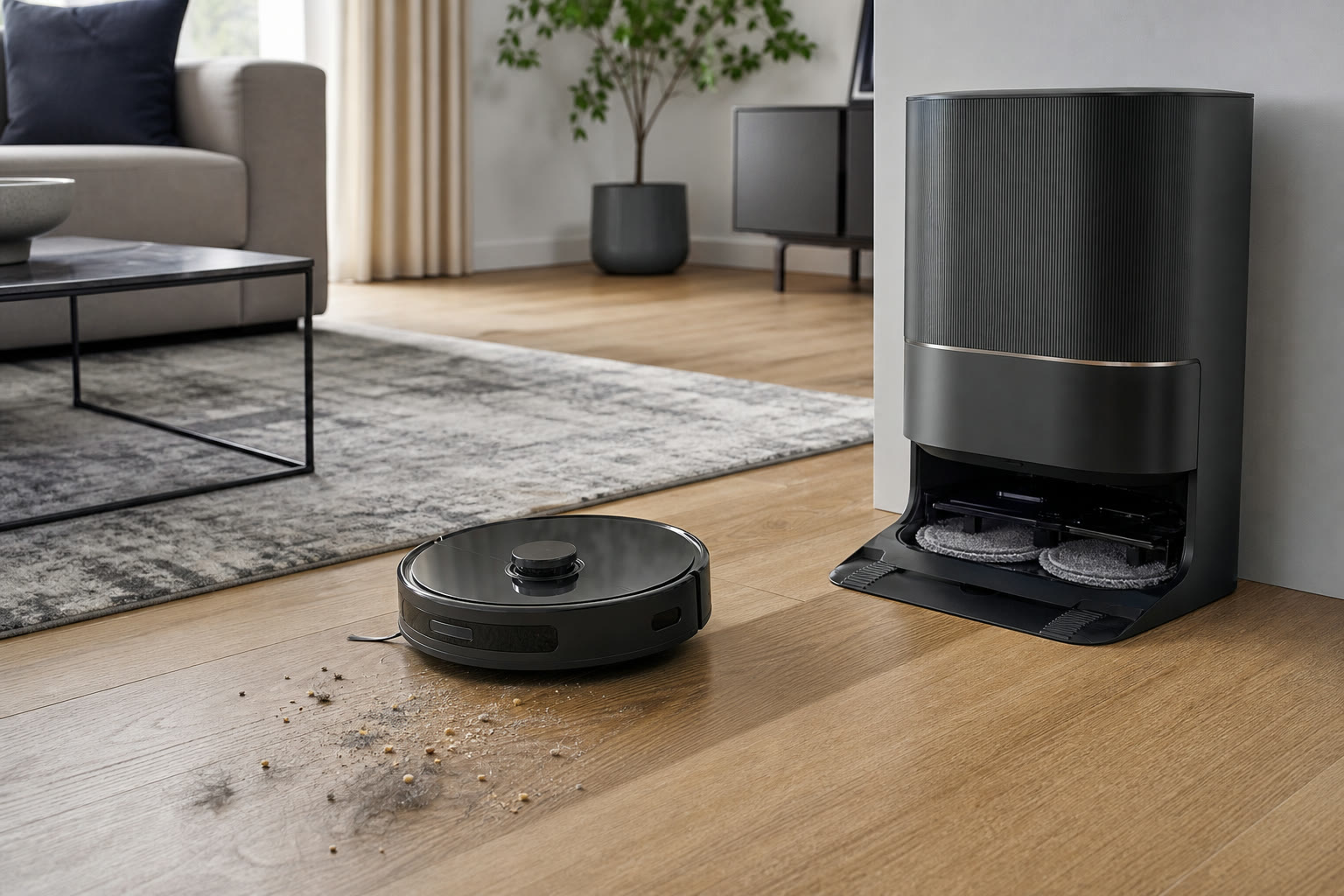
Had it run while I was dealing with a few errands, then came back to a living room that looked reasonably picked up. The self-empty base made it feel less like I had to babysit the bin. One minor thing: I still find myself clearing a couple cords before it goes out, but that was easy.